How they see
How does a dog see the world?
Red–green blind, built for motion and dusk


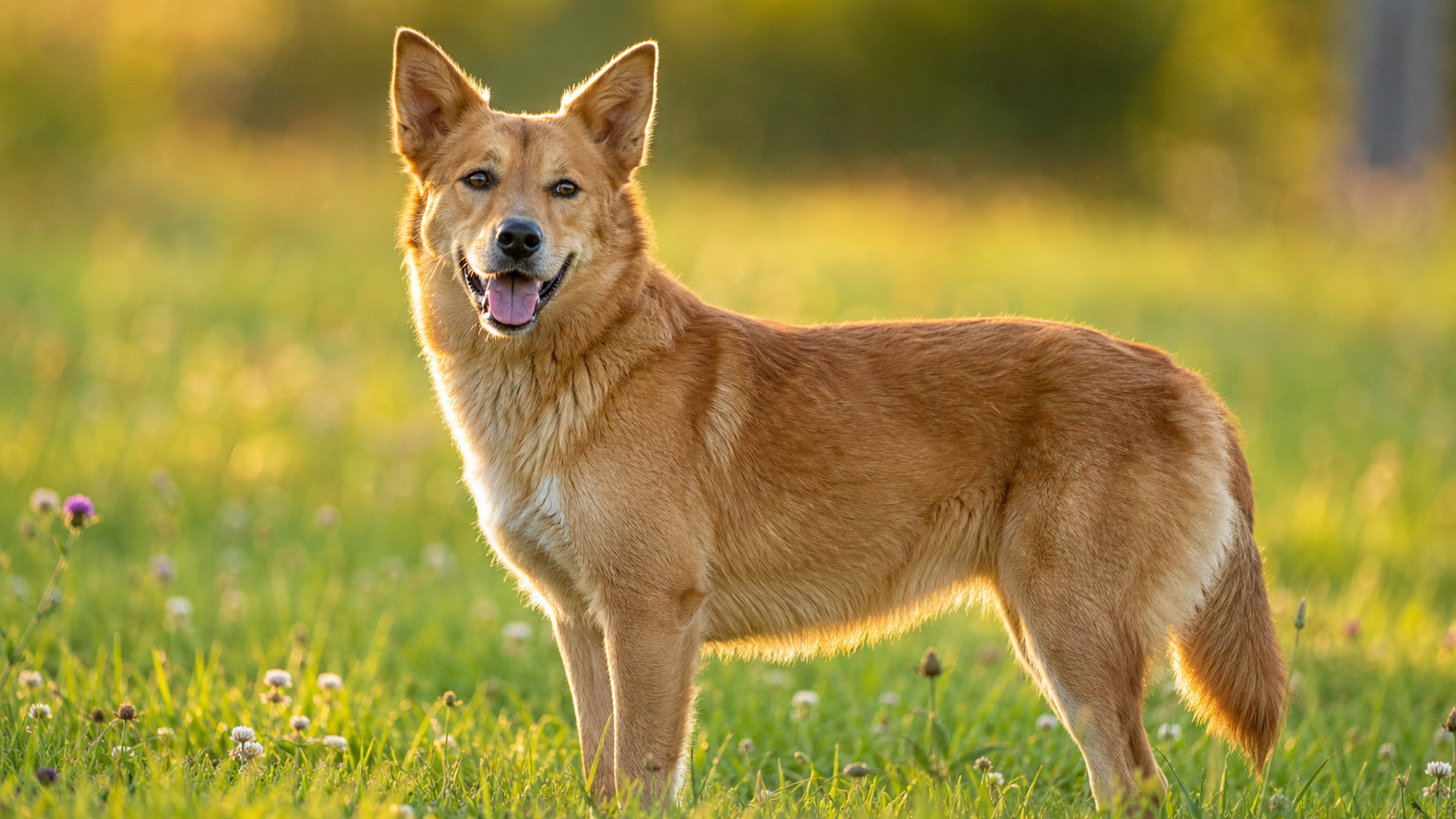
Trot alongside a dog at dusk and you share a world it reads very differently. Its retina gives up fine detail and the full colour palette for something a hunter and companion can actually use: a wide, motion-hungry view that comes alive in low light. Reds and greens fade into muddy yellows, yet a thrown ball or a squirrel's dash leaps out at once.
See through their eyes
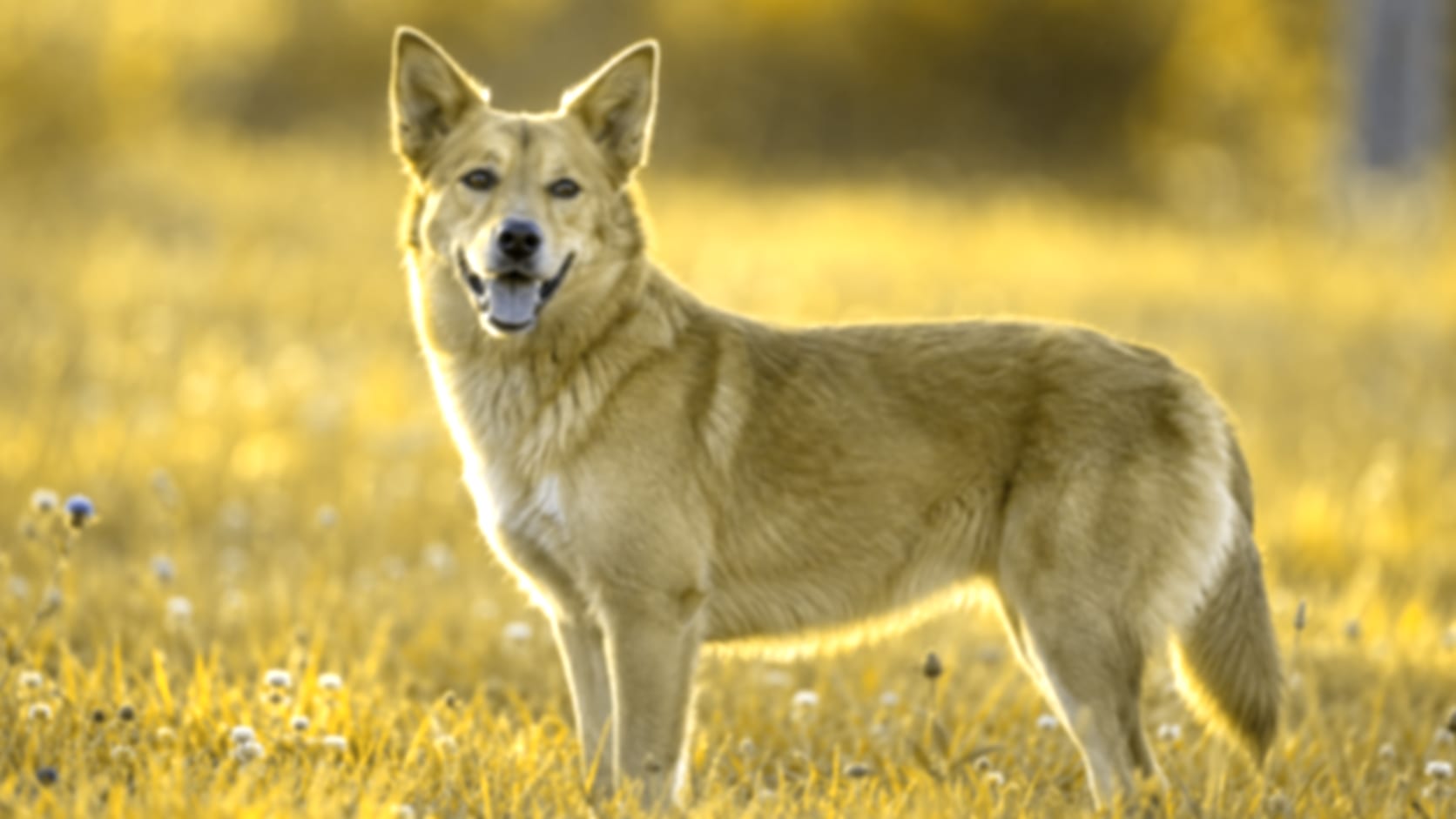

Human ≈ 60 cpd (20/10)
How sharp is a dog's vision?
Its eyes resolve about 12 cycles per degree (20/50), while a human reaches around 60 cpd (20/10). Its field of view spans about 245°.
How does a dog see a human?
Its eyes resolve about 12 cycles per degree against your 60, so a face has to be roughly 5 times closer for it to pick out the detail you do. Your outline and your movement read clearly; your expression does not.
Colour comparison
How each colour shifts when seen through this animal's eyes, using the same colour model as the app. Tones a screen can't emit (such as ultraviolet) are shown as an approximation.
What colours can a dog see?
Sees blues and yellows; cannot distinguish red from green (both look yellowish-grey). A red ball on grass is found by smell and motion, not colour.
Photoreceptors
Dichromat (2 cone types) + rod-rich retina
Cone peak sensitivities
- S (blue-violet)429 nm
- L (yellow-green)555 nm
How does a dog see in the dark?
Tapetum lucidum + rod-dominant retina: needs roughly a quarter of the light a human does.
How does a dog's vision compare to a human's?
A dog's fine detail lands near 20/50, well short of your 20/20, and it works with two primary colours instead of three. What it loses in sharpness it takes back after dark: a quarter of your light is enough, across a 245-degree view.
What is special about a dog's vision?
- Excellent motion detection
- Strong dim-light vision
- Wide panoramic field
What the research shows
Two lines of evidence settled the dog's colour vision. Neitz, Geist & Jacobs (1989) used behavioural discrimination tests and found a neutral point near 480 nm, a wavelength dogs could not tell apart from white; Jacobs et al. (1993) then characterised the pigments of dogs and foxes directly, placing the short-wave cone at about 429–435 nm and the longer cone near 555 nm. Acuity has been measured by two methods that broadly agree. Odom, Bromberg & Dawson (1983) recorded visually evoked potentials and found a mean of about 11.6–12.6 cpd, and Lind et al. (2017) tested dogs behaviourally, with individuals ranging from 5.5 to 19.5 cpd and averaging about 11.8. Murphy et al. (1997) recorded lower evoked-potential values, 7–9.5 cpd, in beagles.
The page uses 12 cpd, which is 20/50 on the clinical scale, where 30 cpd counts as 20/20. The 20/75 often quoted for dogs is a separate clinical estimate from Miller & Murphy (1995), so the two figures are not exact conversions of each other. Coile, Pollitz & Smith (1989) measured flicker fusion behaviourally at roughly 70–80 Hz, and the field of view, about 240–250 degrees, varies with skull shape. Byosiere et al. (2018) review this work. The colour transform borrows a matrix built for human deuteranopes, whose surviving cone sits close to the dog's 555 nm pigment: it shows which colours collapse together, not the exact position of a dog's neutral point, and a still frame cannot carry faster flicker fusion or motion sensitivity.
Guides: Dog vs cat vision, compared · Are animals colour blind? · Which animal has the best eyesight? · All guides
Scientific sources
- Neitz, Geist & Jacobs (1989)
- Miller & Murphy (1995)
- Byosiere et al. (2018)
- Odom, Bromberg & Dawson (1983)
- Lind et al. (2017)
Download Animal Vision
Point your camera at anything and watch the world transform into this animal’s vision in real time.


