Dog vs cat vision: how their eyes really compare
Dogs and cats are both red–green colour blind, but they are built for different jobs. A dog's eyes are about 2.4 times sharper than a cat's and cover a wider sweep of the horizon; a cat's eyes gather more of the night. Here is how the two compare, measure by measure, and where each number comes from.
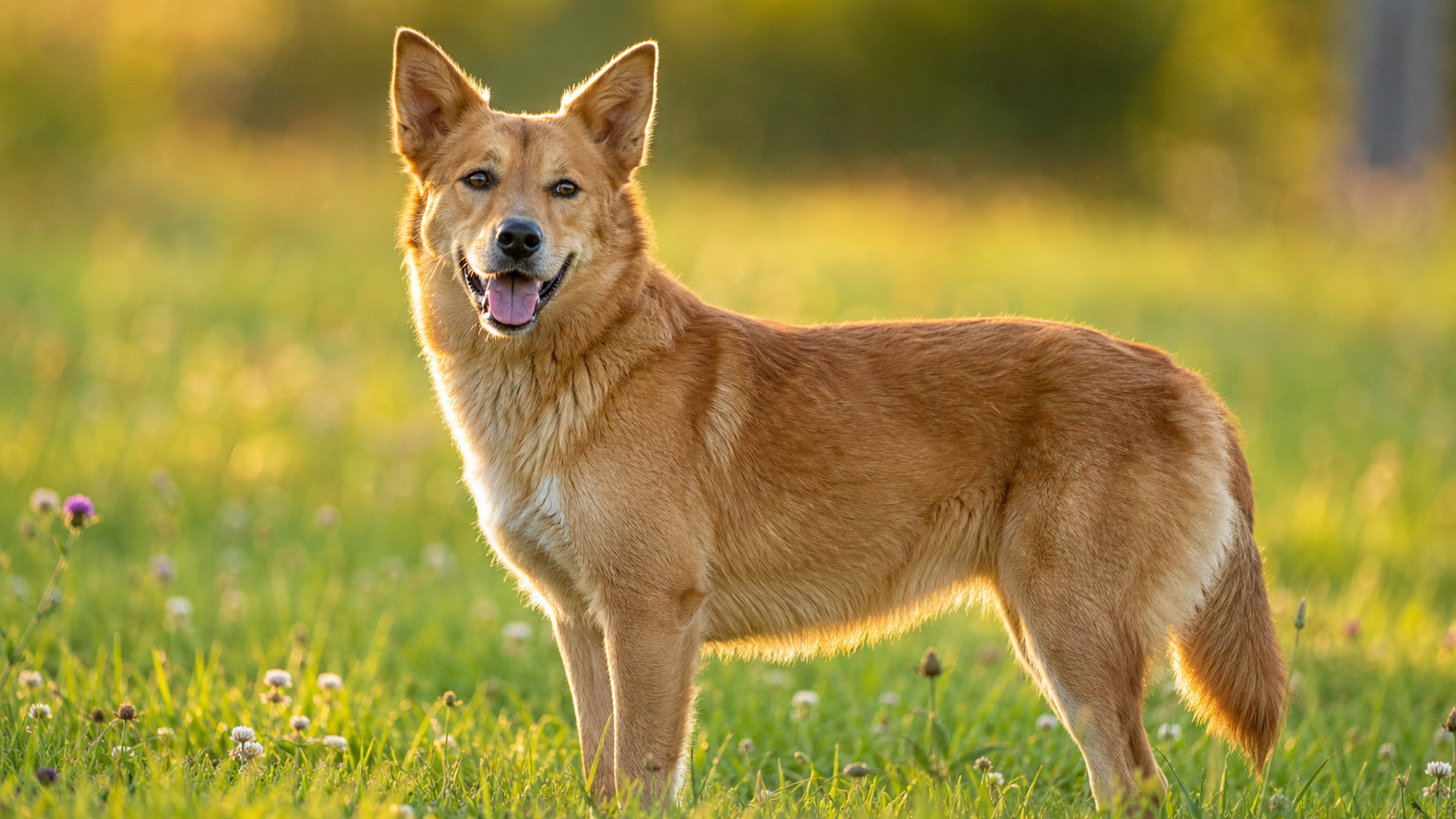
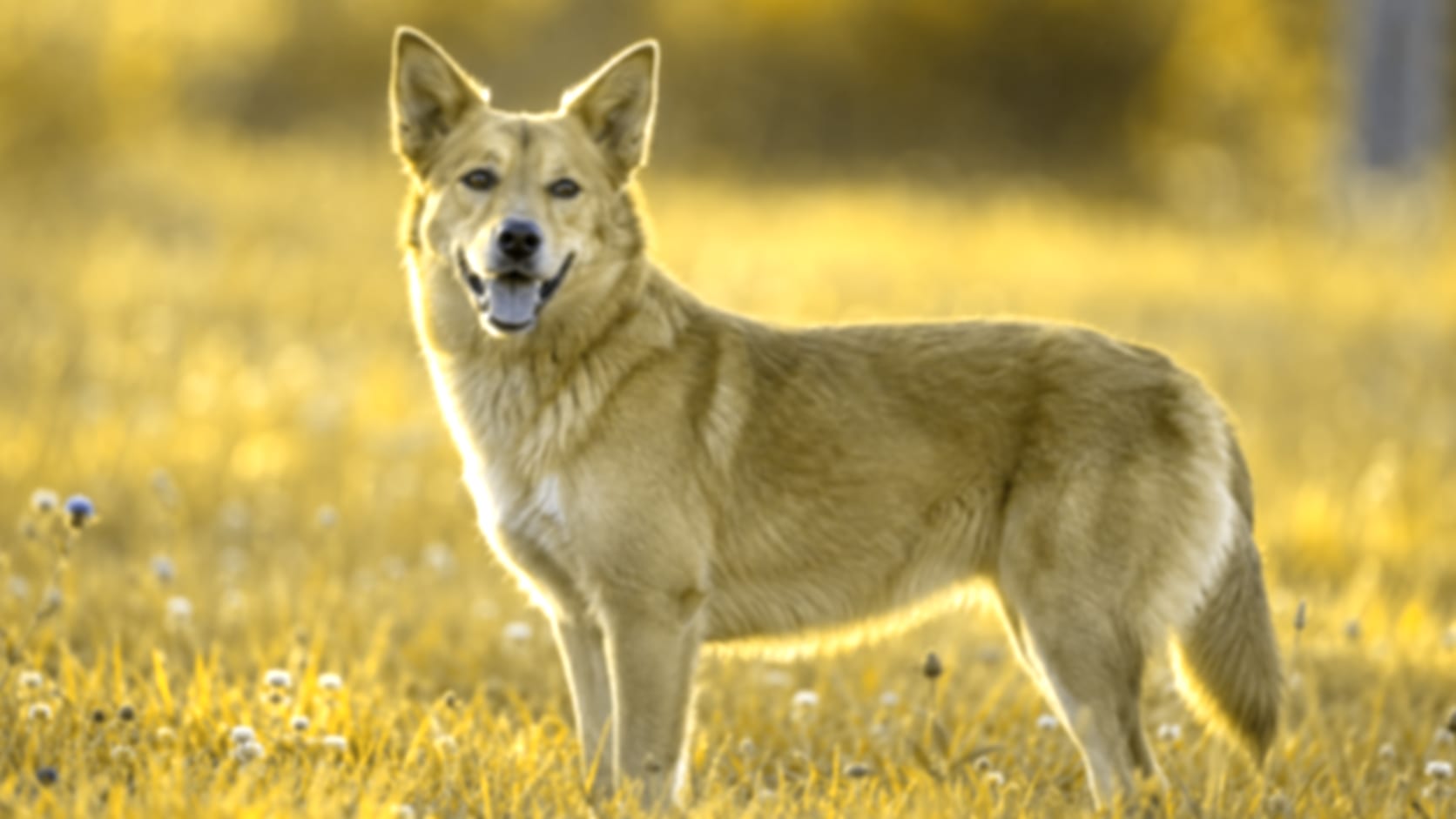
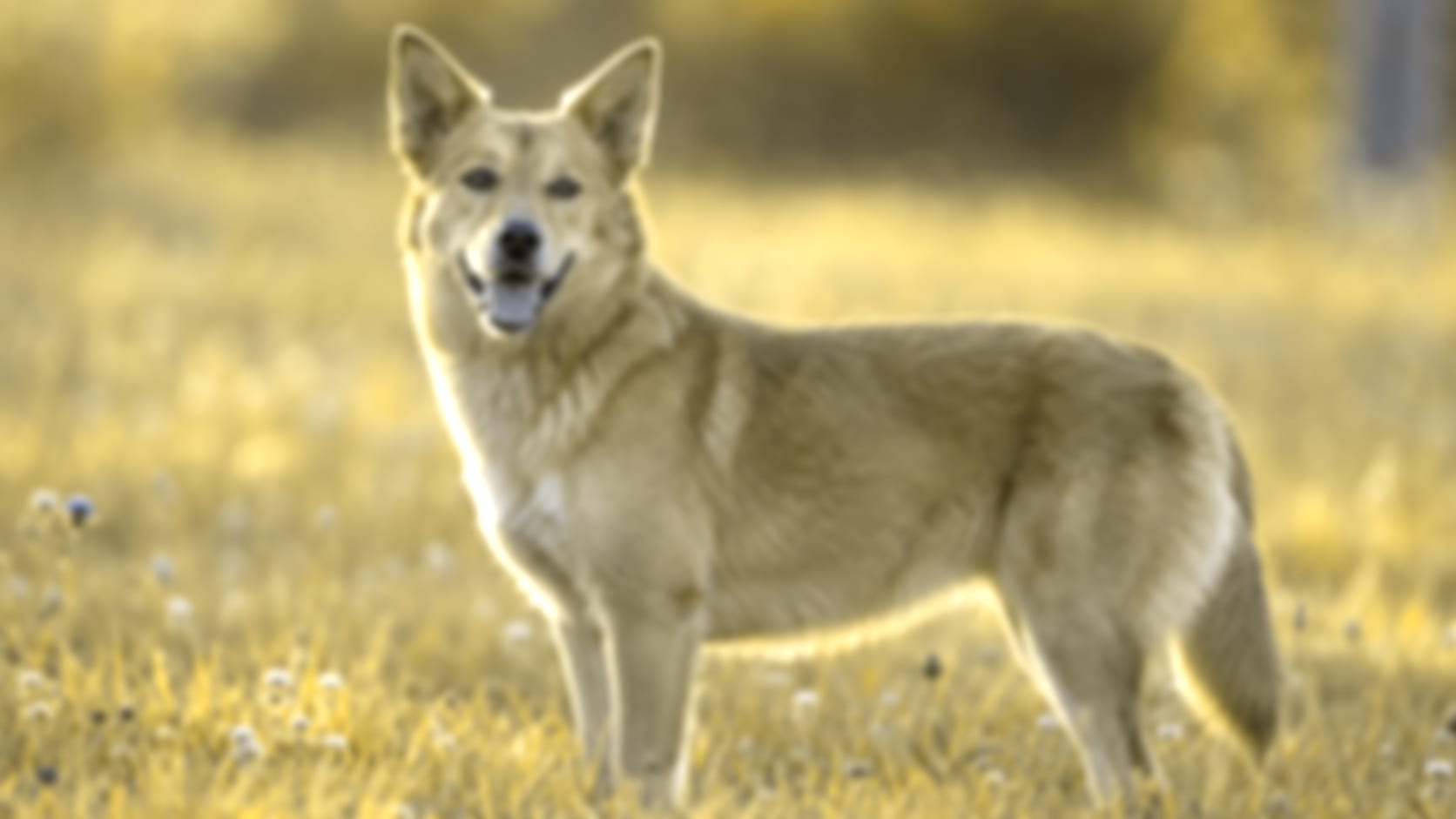
One photograph, three models: colour through each species' cone pair, sharpness through its measured acuity. It shows what information reaches each retina, not what either animal experiences.
At a glance
| Dog | Cat | Human | |
|---|---|---|---|
| Cone types | 2 (429 nm + 555 nm) | 2 (450 nm + 550 nm) | 3 (420 nm + 534 nm + 564 nm) |
| Sharpness | 12 cpd · 20/50 | 5 cpd · 20/120 | 60 cpd · 20/10 |
| Field of view | 245° | 200° | 200° |
| Overlap of both eyes | 60° | 100° | 120° |
| Flicker fusion | 75 Hz | 55 Hz | 60 Hz |
| Light needed at night | about ¼ of a human's | about ⅙ of a human's | — |
Colour: both red–green colour blind, in slightly different ways
Both animals have two kinds of cone where we have three, which makes them dichromats. The dog's pair peaks near 429 and 555 nm. The case rests on two kinds of evidence: Neitz, Geist & Jacobs (1989) trained dogs to tell colours apart and found a wavelength near 480 nm that they could not distinguish from white, and Jacobs et al. (1993) measured the pigments of dogs and foxes directly. The result is a world of blues and yellows in which red, orange and yellow-green collapse into shades of yellow — much like a person with deuteranopia.
The cat's cones sit near 450 and 550 nm (Loop, Bruce & Petuchowski, 1979; Guenther & Zrenner, 1993). A weak third mechanism around 500 nm has been reported, but it is contested, and in behavioural tests cats lean on brightness far more than on hue. In practice a cat is the more colour-blind of the two: its world is paler than a dog's, which is why the cat image above is the most washed out of the three.
Sharpness: the dog wins, by a lot
Acuity is measured in cycles per degree — how many stripe pairs an eye can still separate within one degree of view. People reach about 60. For dogs, Miller & Murphy (1995) put vision near 20/75, and behavioural grating studies range widely with light and method; Lind et al. (2017) found some dogs beating the classic figure of about 11.6 cpd in bright light. This site uses 12 cpd. Cats come out lower: Blake, Cool & Crawford (1974) and later work place them at roughly 4–9 cpd, commonly quoted as 20/100 to 20/150, and this site uses 5. The eye-chart scores in the table use the clinical scale, where 30 cpd counts as 20/20 — so a sharp human eye at 60 cpd is 20/10, the dog's 12 cpd is 20/50 and the cat's is 20/120.
Put simply, detail you can make out from 20 metres away, a dog needs to be about 4 metres from, and a cat about 2 metres. A cat also struggles to focus on anything very close — which is why it sniffs a treat held under its nose instead of looking at it.
Night vision: the cat wins
Both species have a tapetum lucidum, the reflective layer behind the retina that makes their eyes shine in a torch beam and gives light a second pass at the photoreceptors. The cat pushes further. Its retina reaches a peak rod density around 460,000 per square millimetre, about three times a human's, and it needs roughly one-sixth of the light we do; a dog needs about a quarter. The cat's vertical slit pupil also closes far tighter in sunlight and opens wider at night than a round pupil can, giving it a huge working range.
Field of view and motion
A dog's eyes sit further to the side, so it takes in about 245° of the horizon — more in long-nosed breeds — with a smaller zone seen by both eyes. A cat's eyes face forward: about 200° in total but a much wider binocular overlap, the arrangement of an ambush hunter judging a pounce. Both are strongly tuned to movement. Coile, Pollitz & Smith (1989) measured dog flicker fusion around 70–80 Hz, which is why old television sets that looked steady to us flickered for dogs; for cats the classic figure is about 55 Hz.
The short answer
- Sharper eyes: dog (12 cpd against 5).
- Better night vision: cat (about ⅙ of our light against ¼).
- More colour: dog, slightly; both are red–green colour blind.
- Wider view: dog (245° against 200°); better depth for pouncing: cat.
Full articles: how dogs see · how cats see.
Sources
- Neitz, Geist & Jacobs (1989)
- Jacobs et al. (1993)
- Miller & Murphy (1995)
- Lind et al. (2017)
- Coile, Pollitz & Smith (1989)
- Loop, Bruce & Petuchowski (1979)
- Guenther & Zrenner (1993)
- Blake, Cool & Crawford (1974)
See it through their eyes
Animal Vision applies these same vision models to your phone camera in real time.


© 2026 Animal Vision · animalvision.app